Sir Jacob’s Laced Duel Peerage Scabbard

A friend of mine was getting knighted, and this was his second peerage (the first being a Master of Defense). To mark the occasion, I volunteered to make a scabbard for his sword.
He mailed me the existing scabbard to modify as he made modifications to the sword. The scabbard had a leather core scabbard with a black leather cover. Ordinarily, I would have preferred to start from scratch; but, without the sword, I could not make a wood-core that would fit the blade tightly. So, I began work with the existing leather core.
Supplies
An existing scabbard
0.8 mm leather
A white belt blank (about 2 inches wide and 72 inches long)
Belt hardware of your choice
Chromoly tanned leather (white)
String
Hot glue (with a hot glue gun)
A needle or sewing
Artificial sinew
White embroidery floss
Soft-bristled paint brush
Miniature painting brush
Tooth picks
Black leather dye
White leather paint
White acrylic paint
Gold acrylic paint
Red acrylic paint
Leather seal
Acrylic seal
X-acto knife
Scissors
Super glue
Wood glue
Part I: Prep work
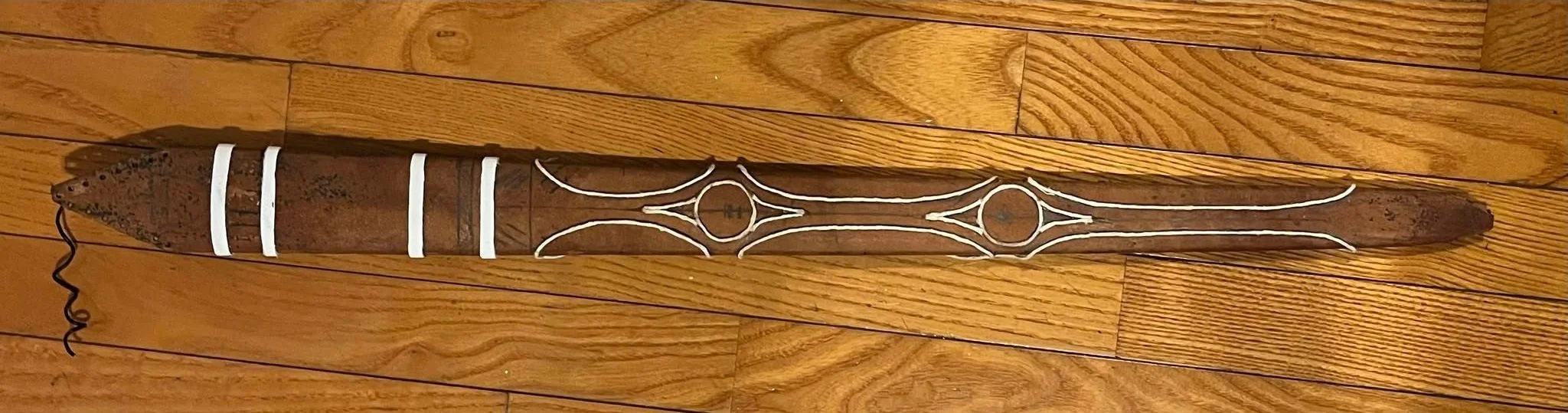
I stripped the outer-layer of leather off the scabbard and pried off the chape. I saved the chape, as it would be needed later. I then began gluing down the raisers. For the raisers, I used string for the thinner lines (cooking or gardening string should work). I used thin leather for the broader raisers that would frame the belt. To hold the raisers in place, I used hot glue. The glue does not need to be strong, just strong enough to keep anything from moving while the cover leather is going on. Hot glue does this job well, and it’s fast drying so things won’t move around and I can keep working.
Part II: Covering
The cover leather is 0.8 mm veg tan leather. I cut out a portion to wrap around the scabbard and soaked the leather thoroughly in water. After wiping away the excess water, I punched a series of holes along the back seem. To sew up the leather around the core I used artificial sinew. As I was sewing, I pressed the drying leather around the raisers so that the outer layer would shape closely to the contours of the design underneath. I had a tool for this. It went… somewhere. So instead, I used a rounded piece of metal (I think it was the discarded tongue of a buckle). Anything sufficiently hard, rounded, and narrow should do the job.


As one would imagine, this phase takes a lot of time. Thus, re-wetting the leather may be necessary. A wet paper towel or cloth should do the job. Don’t try to re-submerge the outer leather once you start sewing it around the core.
Jacob requested that the scabbard have a laced sword belt. If art from the period is any indication, laced sword belts were extremely popular during the High Middle Ages through the early to mid-14th century. From my experience making this piece, I can see why - the scabbard is an integrated part of the belt so it won’t come off, the whole set-up fits tightly to the body, and there is little to no jostling from the scabbard while the wearer is moving around. The downside is there is basically no adjustability - once the scabbard is on and in place, it’s staying there. There is also a lot of prep work that goes into getting a scabbard ready to be laced onto the belt.

The first part of the prep work is cutting the notches where the belt will be laced into the scabbard. I put these notches between the raisers, so the raisers would help hold the belt in place and put less strain on the scabbard’s leather. I then took another piece of leather and wove it into the notches to help hold the gaps open until the belt was ready. I did this on both the front and back of the scabbard. The next step was dying.

Part III: Dying and Painting
Jacob requested the scabbard be largely black and white, reflecting his household colors. This was easy to do as I had almost a gallon of black leather dye (if you plan on doing more than one project, it is seriously worth buying in bulk if you can). I applied about three coats in smooth even strokes with a soft-bristled paintbrush to ensure a uniform color. I then applied two coats of leather seal to help keep the black dye from bleeding through.
I had white acrylic paint and white leather paint. The white leather paint dries smoothly with a lovely evenness, but it goes on very thing. So, I used a base layer of white acrylic which goes on thicker. I painted along the raisers of the scabbard to help them pop even more against the black leather. I ended by applying a couple more layers of leather seal.

At this point I had made enough progress to re-attach the chape. Jacob indicated he might try to brass the chape at some point. To facilitate this, rather than attaching the chape with two-part epoxy (which is my normal practice) I glued the chape on with essentially wood glue. That way the chape would stay on for a while, but it could be easily pried off when the time comes.

Jacob requested that symbles from his peerage be incorperated into the scbbard’s design. To do this I made two circles in which to place the white belt of the Order of Chivalry and the crossed swords of the Order of Defence. I got a couple of post-it notes, measured out the spaces I had in the raised circles of the scabbard, and drew the symbles to a scale that would fit. I then placed the notes on the scabbard, and began tracing the pattern onto the scabbard. Once there were faint indentations where the patterns would go, I painted the symbles in place with leather and acrylic paints. Then, more seal!

Part III.5: The Mouth
To add to the black and white design, I took some white chromoly tanned leather, and sewed a band of it around the mouth of the scabbard with white embroidery floss. I cut notches in the leather to accommodate the sharp angles of the mouth’s rain guard (that extra bit of leather that rises above the mouth). One notch was a bit wider than it needed to be, so I used some superglue to close it up near the end of the project.
Part IV: The Belt
Jacob was kind enough to acquire hardware for the sword belt from Armor and Castings. However, I needed to figure out the belt. It needed to be wide enough that it could be split in half without losing strength. Ordinarily I would make the belt, but I do not know how to dye leather white. I was able to find a vendor from which to buy a white belt blank. I got the blank about 2 inches wide and 72 inches long (and I needed most of it). I had to shave off a bit of width to the blank to fit the belt hardware, but not much.
Based on the few examples I could find, the split in the belt is not symmetrical (one part is narrower than the other). I cut one side to be 1/2-3/4 inch wide. This narrower part was fed through the gaps between the upper raisers (creating a black and white stripe pattern).

The narrow belt strap was then fed around the back through the additional back gaps. Then I looped the narrow end back though the gap at the base of the split in the belt, back under the belt, and around the scabbard again.

I know that is confusing, I will have to do a video of it at some point.
At this point take the wider end of the belt and pass it diagonally in front of the scabbard. I cut an oblong hole into the wider part of the belt right on the middle. I then cut a couple notches in the scabbard where the hole will line up. I soaked a Q-tip with water and wetted the underside of the scabbard’s cover leather through the notch to loosen this leather. I pulled this loop of leather up from the scabbard rough the hole cut in belt (slowly and carefully, so I didn’t want it to rip). I then carefully fed the narrow belt end through this loop. At this point, both ends of the belt can be brought back behind the scabbard. At this stage, cut the belt ends to narrow both of them further to about 1/2 an inch.
I cut notches below the lower belt raisers, using a similar process as described above. I then fed the split ends of the belt through these loops and tied off the belt. The end of the belt felt like a fun place to put the buckle (handy as well) so that is where I attached it. On to the bottom belt!
I took a length of leather, about 3 1/2 feet for the bottom belt. I then wrapped one end of the belt around the scabbard, between the lower raisers, and marked where I would need to punch holes. I then punched the aforementioned holes, and sewed the belt closed around the scabbard using white embroidery floss. Afterwords, I attached the belt chape to the other end of the belt.

Honestly, I’m kind of amazed I didn’t mess that up.
Part V: Suprise! More painting!
I did not manage to paint on Jacob’s heraldry beforehand, and he was getting knighted the next day…. blast. Well, the night was young, so forward!
I drew his heraldry on a sticky note, and traced it onto the scabbard just below the mouth. I then (using a miniature painting brush and occasionally toothpicks) painted his device. Finally, I went over the heraldry and the rest of the scabbard with an acrylic seal to give a more matte finish.

Which brings us to the end. I’m quite pleased with how this turned out. Congratulations, Jacob! May it serve you well.

